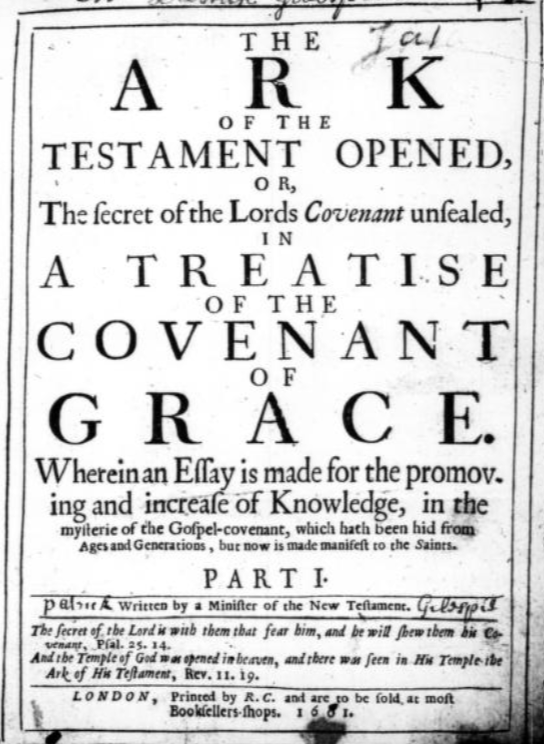
Selected from Patrick Gillespie’s Ark of the Testament Opened, Chapter 1: Of the dignity and excellency of the subject matter; or of the desireableness and usefulness of the doctrine and knowledge of the Covenant of Grace.
Transcribed and edited by Dakota Michael.

should not think the introduction were unsuitable to the treatise, if in the entry I could so commend the excellency and usefulness of the doctrine of the Covenant of Grace, as to render the knowledge thereof in higher esteem and more desired. That I may then waken up in myself and others an eagerness of desire, and even a hungering and thirsting after the excellency of the knowledge of Christ Jesus (Phil. 3:8), who is the marrow and sum of the Gospel Covenant, whom God hath given for a Covenant to the people (Isa. 42:6) and a diligent searching after the hidden wisdom of God’s covenant dealings with his people, as for hid treasures (1 Cor. 2:6; Prov. 2:4), let the dignity and desirableness, the excellency and usefulness of the subject matter be well weighed.
Some things have an intrinsic value which God has stamped upon them—it results from the nature of the things: gold is more excellent than stones. For brass I will bring gold, and for iron I will bring silver, and for wood brass, and for stones iron (Isa. 60:17). Other things have no value but extrinsic. The applauses, excellent elogies, praises, titles and honors given unto men, are merely extrinsic, they add no intrinsic worth to the creature to whom they are given; he remains the same, though he passes at a higher rate: For when he dieth he shall carry nothing away: his glory shall not descend after him. Man that is in honour, and understandeth not, is like the beasts that perish (Psal. 49:17, 20). This made the Philosopher say, honor est in honorante non in honorato. Some things, again, have an intrinsic value, and a supervenient worth also stamped upon them, which flows from their usefulness; and these are the most excellent: bread has an intrinsic worth stamped upon it by God, that man might live by it (Luk. 4:4), and it has a supervenient worth also stamped upon it by the necessity of hungry man, to whom a piece of bread is more useful and excellent than so much gold; this additional value of esteem is supervenient to the intrinsic value thereof: The full soul loatheth an honeycomb; but to the hungry soul every bitter thing is sweet (Prov. 27:7); And Esau said to Jacob, Feed me, I pray thee, with that same red pottage; for I am faint: therefore was his name called Edom. And Jacob said, Sell me this day thy birthright. And Esau said, Behold, I am at the point to die: and what profit shall this birthright do to me? (Gen. 25:30-32).
The subject matter of which I intend to treat, may be will accounted amongst the most excellent things which partake of intrinsic worth stamped upon it by God, and of a supervenient worth also in regard of its usefulness to lapsed man, which has raised the rate and value thereof, and brought it in high esteem among persons knowing in this mystery: The law of the LORD is perfect, converting the soul: the testimony of the LORD is sure, making wise the simple. The statutes of the LORD are right, rejoicing the heart: the commandment of the LORD is pure, enlightening the eyes. The fear of the LORD is clean, enduring for ever: the judgments of the LORD are true and righteous altogether. More to be desired are they than gold, yea, than much fine gold: sweeter also than honey and the honeycomb. Moreover by them is thy servant warned: and in keeping of them there is great reward (Psal. 19:7-11); Although my house be not so with God; yet he hath made with me an everlasting covenant, ordered in all things, and sure: for this is all my salvation and all my desire, although he make it not to grow (2 Sam. 23:5); Yea doubtless, and I count all things but loss for the excellency of the knowledge of Christ Jesus my Lord (Phil. 3:8); Happy is the man that findeth wisdom, and the man that getteth understanding. For the merchandise of it is better than the merchandise of silver, and the gain thereof than fine gold. She is more precious than rubies: and all the things thou canst desire are not to be compared unto her (Prov. 3: 13-15).
(1) First, of the dignity and excellency of the knowledge of the Covenant of Grace, which may and ought to render it desirable: all knowledge is desirable according to its excellency. Knowledge is dignified with intrinsic and real excellency, or is in esteem and high account among men, from various grounds, all which meet together, and are much more eminently in the knowledge of the Covenant of Grace.
First, knowledge is dignified and esteemed from the rareness of it; that knowledge which every one has attained, no man has in esteem; the commonness of things derogates much from their value among men—though I know not why it should—but if any knowledge receives value from rareness, this ought much more, for it is of all knowledge the rarest. The saving knowledge of the Gospel Covenant, is no common knowledge, but a rare thing, not communicated to all men, but to some only: it is given unto you to know the mysteries of the kingdom of heaven, but to them it is not given (Matt. 13:11): not communicated to the greater part of men, but only to a small remnant according to the election of grace (Rom. 11:5); Even the Spirit of truth; whom the world cannot receive, because it seeth him not, neither knoweth him: but ye know him; for he dwelleth with you, and shall be in you (John 14:17), and thine they were, and thou gavest them me, and they have kept thy word: for I have given unto them the words which thou gavest me, and they have received them, and have known surely that I came out from thee, and they have believed that thou didst send me (John 17:6, 8). Yea, this knowledge is so rare, that it is not—for most part—communicated to the men of greatest knowledge, and who have greatest advantages of knowledge of all other men: O father, … thou hast hid these things from the wise and prudent, and hast revealed them unto babes (Matt. 11:25); Which none of the princes of this world knew (1 Cor. 2:8); and but we preach Christ crucified, unto the Jews a stumblingblock, and unto the Greeks foolishness; for ye see your calling brethren, how that not many wise men after the flesh, not many mighty, not many noble are called (1 Cor 1:23, 26).
Secondly, knowledge is had in esteem from the manner of acquiring it: if there is anything rare and singular, in the way of coming at it, this raises the rate of that knowledge by fifty on the hundred. Hence are these enquiries, Whence hath this man this wisdom? (Matt. 13:54). We ask how men come to have this knowledge and lay at wait to value it accordingly: hence are despisings, We know this man whence he is (John 7:27). We decry home-bred knowledge in most sciences—I would there were reason for it. We cry up that which is from far, though it were no better than that which is at our door. We ask where such a person studied, and look not what knowledge he brings, but from whence. But if anything in the way of acquiring knowledge may commend it, there is more of that kind in the knowledge of Christ and the Covenant of Grace than in any knowledge beside. For first, it was brought from far, it came from heaven. This knowledge came out from God, from the bosom of the father (John 1:18). All other knowledge, the farthest fetched is but from beneath, this only is from above (John 8:23). Secondly, he is a great doctor that teaches this knowledge. There is no rabbi like unto him: no man hath seen God at any time; the only begotten Son, which is in the bosom of the Father, he hath declared him (John 1:18); the secret of the Lord is with them that fear him; and he will shew them his covenant (Psal. 25:14); Rabbi, we know we know that thou art a teacher come from God (John 3:2) and Nathaniel answered and saith unto him, Rabbi, thou art the Son of God; thou art the King of Israel (John 1:49). Thirdly, no knowledge is acquired in so excellent a way as this: saving knowledge of this subject comes by revelation: but God hath revealed them unto us by his Spirit (1 Cor. 2:10); flesh and blood hath not revealed it unto thee, but my father which is in heaven (Matt. 16:17).
Thirdly, knowledge is had in esteem and veneration among men; with some, for antiquity, with others, for novelty. There is an excess of itching after and dotage upon both extremes, any practice or opinion how unwarrantable and corrupt soever, if it can but lay claim to antiquity, is had in veneration with some men; and any new-coined fancy, or the same old errors put in a new dress, if they can but lay claim to new light, or put on that mask, go current with others. But if the measuring things whether by novelty or antiquity may usher in the esteem and reception of any doctrine, here is a satisfaction to both humors. In the Gospel Covenant are things new and old, which every scribe which is instructed unto the kingdom of heaven…bringeth forth out of his treasure (Matt. 13:52). Here the greatest antiquity and greatest novelty meet together, and yet no wonder, for the doctrine of the Covenant of Grace, is the everlasting gospel (Rev. 14:6), the same doctrine that was preached to Abraham: And the scripture, foreseeing that God would justify the heathen through faith, preached before the gospel unto Abraham (Gal 3:8), yea, to Adam in the promise of the seed of the woman (Gen. 3:15). This is the same doctrine in substance, which was spoken by the mouth of God’s holy prophets, which have been since the world began (Luk. 1:70); That which was from the beginning declare we unto you (1 John 1:1, 3), and yet the same doctrine of Christ and the Covenant of Grace is a new thing and often so called (Jer. 31:22, Isa. 43:19). It is news, and the preaching of it shall continue to be fresh, good news while the world endures (Isa. 52:7): How beautiful are the feet of them that preach the gospel of peace and bring good tidings of good things (Rom. 10:15); And the Angel said unto them, behold I bring you good tidings of great joy which shall be to all people (Luk. 2:10); and this not only to them who never heard this doctrine before, but to the believer who has heard it and received it. The doctrine of the Covenant, that brings righteousness and life to sinners through Christ shall be a new fresh mercy as often as it is heard and received, for Christ is a spring, and the Covenant of Grace is a well wherein new, fresh, sweet waters are to be found every moment: the water that I shall give him, shall be in him a well of water springing up into everlasting life (John 4:14); With joy shall ye draw water out of the wells of salvation (Isa. 12:3). It is by this Covenant of Grace that the LORD’s mercies are new every morning (Lam. 3:22-23). Hence the same Covenant of Grace for substance, is both the Old Covenant and the New Covenant throughout (Heb. 8): the Old or first Testament, and the New Testament (Heb. 9:15, 18; 1 Cor 3:14). Hence Christ is the Lamb slain from the foundation of the world (Rev. 13:8), and he who appeared in the end of the world to put away sin by the sacrifice of himself (Heb. 9:26). Upon the same account also, the Covenant of Grace is the good old way which we are commanded to ask after (Jer. 6:16), and the same is also the new and living way which Christ has consecrated for us (Heb. 10:20), and the commands of this Covenant are new commandments, and yet no new commandments, but old (1 John 2:7-8; John 13:34) for it is his covenant which he commanded for ever (Psal. 119:9) and the word which he commanded to a thousand generations (1 Chr. 16:15) and must therefore be very old, but always fresh and new.
Fourthly, knowledge receives excellency from the subject and according to the excellency thereof so is the knowledge dignified: therefore we ask, Wherein is a man skilled and knowing? In what subject has he knowledge and skill? This gives real excellency to knowledge and the Covenant of Grace, and things therein contained, being without dispute incomparably the most excellent subject of knowledge, like unto which, heaven and earth do not afford another: For who in the heaven can be compared unto the LORD? Who among the sons of the mighty can be likened unto the LORD (Psal. 89:6), and whom have I in heaven but thee? And there is none upon earth that I desire besides thee (Psal. 73:25); My beloved is white and ruddy, the chiefest among ten thousand. His mouth is most sweet, yea, he is altogether lovely (Song 5:10, 16); Thou art fairer than the children of men, grace is poured into thy lips, therefore God hath blessed thee forever, etc. (Psal. 45). The knowledge of God in Christ, and the knowledge of the gospel way of righteousness and life, must needs be the most excellent knowledge, and upon that account should be had in esteem above other knowledge: Yea, doubtless and I count all things but loss for the excellency of the knowledge of Christ Jesus my Lord (Phil. 3:8); this is the Pearl of greatest price and value, for purchasing whereof, all other things may be easily forgone (Matth. 13:45-46). Even Aristotle could say that “a little knowledge, though conjectural about heavenly things, is to be preferred above much knowledge thou certain, about inferior things.”
Fifthly, knowledge is had in esteem, according to the certainty that is attainable in it. The greater certainty that is attainable in any science, the more it is partaker of excellency, and ought to be dignified. Now of all knowledge the greatest certainty is attainable in the knowledge of God through Christ, and in the knowledge of the substantial truths of the Covenant of Grace. For first, here is the greatest certainty of the subject matter, and things treated of, that they are in being: That which was from the beginning, which we have heard, which we have seen with our eyes, which we have looked upon, and our hands have handled of the word of life. That which we have seen and heard declare we unto you, that ye also may have fellowship with us (1 John 1:1-3); He that cometh to God must believe that he is, and that he is a rewarder of them that diligently seek him (Heb. 11:6). [2] Here is the greatest certainty of the mind of man, and the highest assurances that are attainable about anything: And hereby we know that we are of the truth, and shall assure our hearts before him (1 John 3:19); Let us draw near with a true heart in full assurance of faith (Heb. 10:22); For I am persuaded that neither death nor life, etc. (Rom 8:38). [3] Here are the clearest and most firm demonstrations whereby one thing gives evidence to another, as is certainly inferred from another, the like are not to be found in any science: Hereby know we that we know him, etc. (1 John 2:3); we know that we have passed from death unto life, because we love the brethren. He that loveth not his brother abideth in death. Hereby we perceive we the love of God, because he laid down his life for us: and we ought to lay down our lives for the brethren (1 John 3:14, 16); and hereby know we that we dwell in him, and he in us, because he hath given us of his Spirit (1 John 4:13, 15). Yea, all other knowledge is but conjectural, the politicians’ knowledge, the jurists’ knowledge, the physicians’ knowledge, etc. all is but conjectural. Only the knowledge of the gospel and of God in Christ, that is certain and infallible; man cannot possibly reach such a certainty in any knowledge as in this, for herein his knowledge and assurances may rise above deceit and delusion, above mistake, above disputing, above doubting, above daring once to doubt, and to enquire further: For I know that my Redeemer liveth, and that he shall stand at the latter day upon the earth (Job 19:25); Therefore have I set my face like a flint, and I know that I shall not be ashamed (Isa. 50:7); And we believe and are sure that thou art that Christ the Son of the living God (John 6:69); and none of the disciples durst ask him, Who art thou? knowing that it was the Lord (John 21:12).
Sixthly, knowledge is in esteem according to the perfection that is attainable in it: that knowledge is of least value, in which there can be no perfection attained, and that most valuable in which perfection is attainable, and the more valuable by how much it is possible, speedily and easily to attain perfection therein. This also dignifies the doctrine and knowledge of the Covenant of Grace, and gives it the crown above all humane knowledge; for as much as there is no perfection attainable in any other knowledge: That which is crooked cannot be made straight, and that which is wanting cannot be numbered (Eccl. 1:15). Whosoever he be that knows anything in the same, is notwithstanding ignorant of more than he knows, but he that knows God in Christ, and knows the mystery of the Gospel Covenant in the meanest degree of saving knowledge, he knows more than he knows, that he knows: And whither I go ye know, and the way ye know. Thomas saith unto him, Lord, we know not whither thou goest; and how can we know the way? (John 14:4-5). Such a one knows more than all the wise men of the world know: Thou hast hid these things from the wise and prudent, and has revealed them unto babes (Matth. 11:25); Which none of the princes of this world knew (1 Cor. 2:8). In the study of this knowledge only, perfection is attainable, and whosoever will apply himself unto the study of it, shall be proficient, though it were in vita Minerva, yea, and shall be perfected in the knowledge of that mystery. Till we all come in the unity of the faith, and of the knowledge of the Son of God, unto a perfect man, unto the measure of the stature of the fulness of Christ (Eph. 4:13); But when that which is perfect is come, then that which is in part shall be done away. For now we see through a glass, darkly; but then face to face: now I know in part; but then shall I know even as also I am known (1 Cor. 13: 10, 12).
Seventhly, knowledge is in esteem, and ought to be so, according to its usefulness. That knowledge that is good for nothing, is not worth the searching after, that which is useful and profitable for anything, is to be esteemed, and according to the usefulness of any knowledge, so it is proportionably to be had in esteem, and that which is good for most intents, is deservedly in highest esteem. Therefore we ask concerning any piece of knowledge, Wherefore is it good? And, For what is it useful and profitable? And in this respect, the knowledge of the Covenant of Grace carries away the crown and preference from all other knowledge; for whatsoever be the advantage and usefulness of other good knowledge for some ends and purposes; yet the knowledge of no other subject, no other understanding, nor humane science is good for all things, this is peculiar to the saving knowledge of Christ, and of the Gospel Covenant, to be useful and profitable for all things necessary for salvation, whether they concern the being, or well and comfortable being of a Christian: only this knowledge is profitable to make the man of God perfect, thoroughly furnished unto all good works (2 Tim 3:17). For this cause David says of the Covenant, this is all my salvation (2 Sam. 23:5): and when God comes to enter into this Covenant with Abraham, he tells him, that he is God Almighty, and all-sufficient (Gen. 17:1-2), and that he was his Shield and exceeding great reward (Gen. 15:1). What good thing and useful can any soul think of or desire for this life, or that which is to come, but he who knows the Covenant of Grace well can find it promised therein, and he who can practically improve that knowledge can draw his supply of that useful things from the grace of that Covenant: For the LORD God is a sun and shield: the LORD will give grace and glory: no good thing will he withhold from them that walk uprightly (Psal. 84:11); But godliness is profitable unto all things, having promise of the life that now is, and of that which is to come (1 Tim. 4:8): but of the usefulness of the Covenant of Grace, more particularly in a distinct section.
Eighthly, knowledge is esteemed and searched after according to its mysteriousness. The most profound knowledge is in greatest account: all men itch after hidden and secret things, they desire to pry into them. The statesman desires to know the secrets of state, and lays out himself in searching after them. The schoolman loves to agitate profound questions. The natural man desires to know the secrets of nature. The merchant desires to know the secrets of commerce and trade. Yea, the very craftsman desires to know the secrets and hidden things of his own art. Only the Christian comes short in a better and more approved curiosity.Yet, he searches not into the mysteries of the Kingdom of heaven, he pries not as he ought into the secrets and hidden things of the Covenant of Grace. Yet herein are more mysteries to be searched into, and more profound knowledge to be had than anywhere else: But we speak of the wisdom of God in a mystery, even the hidden wisdom, which God ordained before the world unto our glory: which none of the princes of this world knew (1 Cor. 2:7-8). There is a considerable scripture for this: the secret of the LORD is with them that fear him; and he will shew them his covenant (Psal. 25:14). Where the secret of the Lord and his Covenant are one and the same thing, as interpreters note upon the place: the Covenant of Grace is God’s great secret and mystery, wherein he communicates with his people, and which is made known only to those whom he admits to an intimate familiarity with himself. His covenant is his sod or ‘secret’: a word used for privy councils, because of the secrecy, Aquila renders it ἀπόρρητος, or “secret that cannot be uttered”; Symmachus ὁμιλία—“conversation, or conference, or fellowship” with God; Theodotio μυστήριον, the mystery of God; Hierome secretum Domini, and he expounds it of the New Testament or Covenant, which was hid and wrapt up under the veil of the Law. God speaks there as a great king, although he is good to all, and the influence of his good providence extends to all men, yet they who are in his church, his court, his house, have more special privileges. But as all his subjects are not of his court, so all that are of his court, are not of his privy council. These only whom he honors with great trust and intimate familiarity, these are upon his sod, his secret, to whom he shews his Covenant. And indeed the Covenant of Grace contains great mysteries and secrets, the greatest that are in the world, greater than these that men pry most into, greater than natural eyes or carnal minds can see into. For discovering how great a secret this Covenant is, let me instance upon some few of the many mysteries and secrets that are wrapt up in it, and the light that is needful for discovering them.
Are there any mysteries so great? Any secrets so deep as these of the Covenant of Grace? Is not the incarnation of the Son of God a great mystery? The union of the divine and human natures in one person, the two natures that were at so vast distance and variance: yea, without controversy, says the Apostle, great is the mystery of godliness: God was manifest in the flesh (1 Tim. 3:16). God’s being in the form of a servant (Phil. 2:7), the killing of the Prince of life (Acts 3:15), the shedding of the blood of God (Acts 20:28), the humiliation of the high and lofty one (Isa. 57:15; Phil. 2:7), the shame and disgrace of the Lord of glory (Isa. 50:6), the childhood of the Ancient of days (Dan. 7:9; Luk. 2:27), the curse upon God blessed for ever (Gal. 3:13; Rom. 9:5), the condemning of the holy one and the just (Acts 3:14; 2 Cor. 5:21), the justifying of the ungodly, etc. (Rom 4:5), are not these great mysteries? Is not the design of love that acted Christ all along, in laying down his life for his enemies, a great mystery (Rom. 5:7)? Is not our union with Christ a great mystery? The inhabitation of the Spirit in the believer a great mystery (John 6:57, 14:20)? Is not faith a great mystery (1Tim. 3:9; Heb. 11:1)? Regeneration, a great mystery (John 3:3-4)? Is not the love of God a great mystery (1 John 3:1), and the objects of his choice upon whom he has set his love a great mystery? Upon fallen men, not angels (Heb. 2:16). And among men, upon the most despicable, not upon the rich, the noble, the wise, etc. (1 Cor. 1:20; 2 Sam. 7:18)? Where are there any such secrets to be searched into?These are mysteries and secrets which need a pure and clear light to discover them: in thy light shall we see light (Psal. 36:9). Secrets that cannot be opened without the help of him who opened the seals of the Book of the Covenant (Rev. 5:2-9), for the secret of the Covenant transcends [1] Nature’s light, that is too dim and dark a light for opening and discovering so hidden knowledge, yea, it is utterly blind and can reveal nothing to us of Christ and the Covenant of Grace. But the natural man receiveth not the things of the Spirit of God: for they are foolishness unto him: neither can he know them, because they are spiritually discerned (1 Cor. 2:14). This light when it was perfect in Adam before his fall, could not discover this secret, far less the remainders of it that are in us. [2] Nor can all that art can superadd to nature make a discovery of this secret; reason elevated, by all the precepts of morality and rules of virtue above the vulgar capacity, cannot teach this secret, it is a depth and height of knowledge that transcends the most excellent natural spirit of man, the profoundest wits, that have far outstript others in knowledge. The state wits fail here; for this is the subject, which none of the princes of this world knew (1 Cor. 2:8). Yea, and the school wits too, for this was foolishnessto the learned Greeks (1. Cor. 1:23). And if angelic knowledge were superadded to the best humane understandings, all could not do, these also should go to school to study and learn, if not at the church, yet with the church to learn—I say—from a great rabbi and maker the knowledge of this secret: which things the angels desire to look into (1 Pet. 1:12); To the intent that now unto the principalities and powers in heavenly places might be known by the church the manifold wisdom of God (Eph. 3:10); Even so the things of God knoweth no man, but the Spirit of God. Now we have received, not the spirit of the world, but the spirit which is of God; that we might know the things that are freely given to us of God (1 Cor. 2:11-12); Rabbi, we know that thou art a teacher come from God (John 3:2).

Patrick Gillespie
Patrick Gillespie (1617–1675) was born 2 March 1617, and educated at St. Andrews University, where he graduated in 1635. In 1642, he became minister of the second charge of Kirkcaldy, and of the High Church of Glasgow in 1648. From that time he took a very prominent part in public affairs. He strenuously opposed any peace with the King, being a stout supporter of Cromwell, and was a leader in the group known as the protesters. He considered the terms made with Charles II unsatisfactory, and after the battle of Dunbar (3 September 1650) he helped raise an armed force, which was placed under the command of officers recommended by him.
He was the author of the ‘Remonstrance’ (December 1650) addressed to Parliament in which the protesters made the gravest charges against the public authorities, and condemned the treaty with the king. This seditious paper was condemned by church and state. Soon after the commission of assembly passed resolutions in favour of allowing all those who had been previously considered undesirable, on profession of their repentance, to take part in the defence of the country. Supporters of this commission were known as resolutioners. Against this Gillespie and his friends protested, and as the General Assembly, which met in July 1651, was likely to approve of the resolutions of the commission, they protested against its legality. For this he and two others were deposed from the ministry. They and their sympathisers disregarded the sentence, and made the first schism in the church since the Reformation.
There was now no one in Scotland who was in greater favour with the Protector, or who had more influence with him than Gillespie. Hence his appointment as Principal of the University of Glasgow in 1653. Protests that Gillespie was inexperienced in teaching, had been deposed from the ministry, and that the election belonged to the professors, were waved away. Gillespie’s record at the University is mixed. He spent lavishly on building projects, but left the University heavily in debt. Toward the end of his time in office he demolished a portion of the old buildings without building replacements, which had then to be done by his successors.
In 1653, Cromwell turned the General Assembly out of doors, and in the following year he called up Gillespie and two other protesters to London to consult with them as to a new settlement of Scottish ecclesiastical affairs. The result was the appointment of a large commission of protesters, who were empowered to purge the church of ministers whom they thought scandalous, and to withhold the stipend from any one appointed to a parish who did not possess a testimonial from four men of their party. This was known as ‘Gillespie’s Charter’, and was particularly odious to the resolutioners, who formed the great majority of the church.
In 1655, Gillespie and other protesters went to London to seek an increase of power. He obtained from the Protector a large addition of revenue to the university out of church property. After his return home he quarrelled with the town council, and was libelled for neglect of duty and maladministration of funds. In May 1659, he again visited London, and obtained from Richard Cromwell an increase to his income out of the college revenues.
At the Restoration, Gillespie’s support of Cromwell and his leadership of the protesters counted against him. He sent his wife to court to intercede for him, but was deprived of his office and imprisoned in Stirling Castle. In March 1661, he was brought to trial. He professed penitence, and threw himself upon the mercy of the court. He had powerful friends, and escaped with a sentence of confinement to Ormiston for a time. He could obtain no further employment in the ministry, and died at Leith in February 1675.

Leave a Reply